On 9 June 2026, Architect Alvaro Millan Cruz, Head of Historical Research and Heritage Rehabilitation at the Instituto Europeo de Innovación (IEI), participated in the conference “Architectural and Documentary Heritage of Professional Associations and Colleges”, organised by the Official College of Architects of Madrid (COAM).
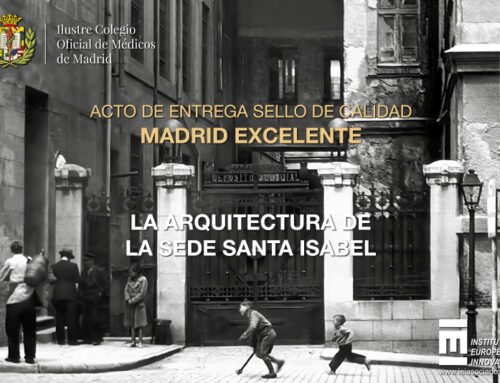
His presentation, entitled “Historical Research: Object and Instrument of Heritage Recovery”, explored the relationship between documentary heritage and architectural heritage through the rehabilitation of the headquarters of the Official College of Physicians of Madrid (ICOMEM).
The conference addressed a particularly relevant issue for institutions that occupy historic buildings: the heritage of professional institutions is not limited to their historic buildings, but also lies in their archives, plans, photographs, records, publications and historical documents. Although these two dimensions (built heritage and documentary heritage) are usually managed separately, they are deeply intertwined when the restoration of historic buildings is carried out.
Using the ICOMEM headquarters as a case study, Alvaro presented the methodology developed by IEI for interventions in historic buildings. The presentation demonstrated that historical research is not simply a preliminary stage or a process of gathering background information. It is a design tool. Through the analysis of archives, plans, photographs, documentary sources and material evidence, it becomes possible to reconstruct the evolution of a building, understand its transformations and provide a more rigorous basis for architectural decision-making.
This approach enables interventions that go beyond the recovery of heritage elements. Historical research can inform decisions relating to the restoration of original spatial configurations, the reorganisation of circulation routes, improvements in accessibility and safety, the integration of environmental strategies and the adaptation of buildings to contemporary uses.
The rehabilitation of the ICOMEM headquarters also illustrates how research can generate new knowledge. Drawings, historical interpretations, technical documentation and architectural analyses produced during the project not only support the intervention itself, but also become part of the documentary heritage associated with the building.
The experience demonstrates that archives are more than repositories of memory. They can become active instruments in the rehabilitation process. At the same time, architectural interventions can enrich documentary heritage by generating new records and new interpretations of the built environment.
This approach reflects IEI’s commitment to a systemic vision of rehabilitation, in which architecture, heritage, sustainability and research work together to preserve, update and enhance the value of our built legacy.
The complete presentation is available on Vimeo at the following VIMEO.
See presentation: from 1h 23’ 57″ to 1h 36’ 36″.